
‘media history’

A modern bálvány: Henry Moore a keleti blokkban
… Flondor, painter, Grigorie Minea, sculptor, Peter Jacobi, sculptor; Adéla Matasová, intermediate artist; György Jovánovics, sculptor, László Gyémánt, painter, Krisztina Passuth, art historian, Márta Kovalovszky & Péter Kovács, art historians. Considered, at the time, the largest international retrospective of the artist, the exhibition, organised by the British Council in cooperation with local authorities in Romania, Czechoslovakia and Hungary, the exhibition featured …

A barátságon innen és túl: Régiós kulturális transzferek a 70-es évek művészetében
… conference convened by Zsuzsa László and Emese Kürti (Central European Research Institute for Art History - Artpool Art Research Center, Budapest) will investigate the concept of cultural transfer and its relevance to the transnational art histories of Central-East Europe in the 1970s. The program is composed of the following five sections: Theories of Translation and Transfer; Interpersonal Friendships and Dialogues; Hubs of Transfer; Agents, Vectors, Mediators; and Institutions of …
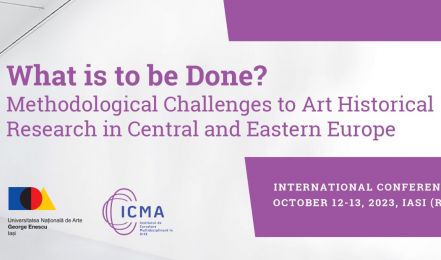
What is to be Done? Methodological Challenges to Art Historical Research in Central and Eastern Europe
… with: Academy of Fine Arts, Prague, KEMKI-Central European Research Institute for Art History, Budapest and the University of Lodz. CONFERENCE PROGRAM Thursday, October 12 9.45 – 10.00 – Introduction 10.00 – 12.00 Panel 1: Revisiting socialist art: state-supported institutions, exhibitions, and cultural diplomacy Tomasz Zaluski – Introduction : In Search of New Agendas. Potential Histories of Art & Modernization Under Socialism Maja and Reuben …

Kurátori tárlatvezetés a Fanzin Anatómia gyűjteményi bemutatón
… that define fanzines, there is a recurring structure that draws on formats present in mainstream media as well: in the collection display, enlarged copies of the publications’ pages and the original fanzines are arranged in successive thematic groups according to these reconstructed genres or ‘columns’. In other words, we have created a fictitious anthology, revealing the typical structural basis of alternative publications, i.e. an anatomy of fanzines. Fragments from publications …